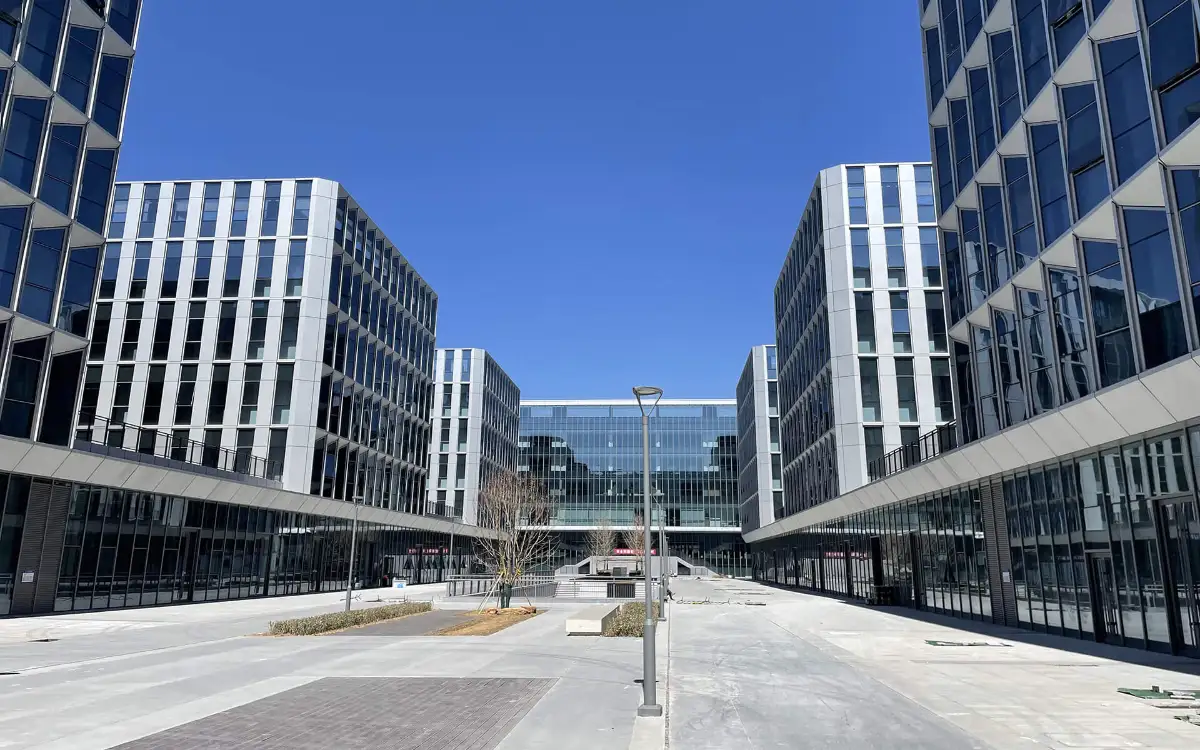
We run an entry hub in Taiyuan, agreed with the municipal government. Nordic SMEs get office space inside the Jinchuanggu zone, help with company setup, and trademark registration in about six months instead of twelve, where the application qualifies.
Case type
Market entry hub
Sector
Cross-sector, with priority lane in green and clean technology
Chinese entity
Jin Innovalley
The entry hub
A cross-sector market entry hub inside one of China's largest industrial transitions
The Jin Innovalley entry hub, anchored inside the Jinchuanggu innovation zone is built to help Nordic SMEs enter China through a structured relationship with the Taiyuan municipal government. It is open to companies across sectors - with a priority lane for green and clean technology, where the provincial government is explicitly seeking Nordic partners.
Structured through formal agreement with the Taiyuan municipal government, the entry hub combines local government backing with hands-on Nordic-side operating support. It provides:
Physical base
Office space and operating presence inside the Jinchuanggu innovation zone, alongside more than 200 enterprises already operating there.
Market entry
Hands-on support navigating the Chinese market - from sector entry strategy to first commercial steps, run by our in-market team.
Company formation
Guidance on company registration, HR, finance, and operational setup. Where local administrative support is available through provincial pilot policies, the entry hub routes it.
Accelerated IP protection
Taiyuan operates a pilot system that reduces intellectual property and trademark registration timelines from approximately 12 months (or more) - the China norm - to six months for eligible applications.
The challenge
Shanxi cannot make this shift on its own technology
Shanxi is China's coal province. For decades it made the energy that built modern China. Now it has to make something else.
Beijing and the provincial government have put money and policy behind that shift. Shanxi is one of six provinces in the Rise of Central China Plan, which channels central funding and industrial modernisation into the inland economy.
The provincial government has been explicit about what it needs from foreign partners - technology, capability, and operating experience in four sectors specifically:
Renewable energy
Solar, wind, and storage capacity matched to grid-scale transition requirements.
Smart grid
Distribution, monitoring, and load-balancing infrastructure for the new generation mix.
Carbon capture
Industrial-scale carbon management, particularly relevant given Shanxi's existing heavy industry base.
Sustainable building
Construction technology, materials, and methods aligned with the province's decarbonisation agenda.
It has the authority, the money and an administration that can act. What it does not have is enough foreign partners who can deliver on time.
That gap is the opening.
The solution
Taiyuan is where the transition is actually run
Taiyuan is where the Shanxi government sits, and where the coal-to-clean shift is actually run. The hub gives you standing inside that. You arrive as a counterparty in the city's own agenda, not as a supplier with a pitch.
Be clear about what Taiyuan is not. It is not a consumer market. Five and a half million people, and nothing like the buying power of Shanghai or Shenzhen.
million
Population of Shanxi Province - one of the six provinces in the Rise of Central China Plan.
million
Population of Taiyuan, the provincial capital - a Tier 3 city designed for relationship entry, not mass-market access.
km
Distance to Beijing by high-speed rail. Travel time under three hours. Inland positioning with real connectivity.
You come here to build government relationships, to hold a China base cheaply, and to sit inside the transition work. You do not come here for retail volume.
For Nordic companies with the right profile, the asymmetry is favourable. At the Tier 1 level, foreign SMEs compete for attention with hundreds of larger entrants. At the provincial-capital level, foreign SMEs entering through a structured platform have direct working access to municipal and provincial decision-makers. The asymmetry favours the smaller, better-targeted entrant.
A purpose-built innovation zone inside the transition
Jinchuanggu sits inside Taiyuan's Zhongbei High Tech Industrial Development Zone. It is one of the principal pilot environments through which the Shanxi transition is being implemented at the municipal level.
The zone focuses on intelligent industry, digital transformation, smart manufacturing, and green technology. It is structured to attract both Chinese domestic enterprises and foreign-invested projects that align with the provincial transition agenda.
Foreign firms inside the zone access provincial R&D incentives, talent subsidies, and joint-innovation programmes.
Taiyuan's defined roles
Provincial capital
The seat of the Shanxi provincial government. Direct administrative access to provincial-level industrial transition policy and budget.
Transition demonstration zone
Part of the Shanxi Transformation and Comprehensive Reform Demonstration Zone - the principal vehicle through which provincial-level policy experimentation is run, with formal focus on new materials, energy-saving and environmental protection, green food, tourism, and healthcare.
Innovation cluster
Anchored by the Jinchuanggu innovation zone in the city's Zhongbei High Tech district. Active concentration of digital transformation, smart manufacturing, and green-tech enterprises.
Connectivity hub
High-speed rail to Beijing in under three hours; lines to Xi'an, Zhengzhou, and Shijiazhuang. Wusu International Airport operates 94 routes covering 69 domestic, regional, and international cities.
The logic
Why this structure
Why a hub, not a vendor relationship
Shared institutional standing across multiple SMEs reduces per-company cost and surfaces faster than individual entries. The hub is not a JV; each company enters on its own commercial terms.
Why government counterpart, not private partner
Regulatory standing, policy alignment, and direct access to the provincial transition budget. A private partner cannot provide that.
Why Taiyuan, not another inland capital
The only inland capital with all three: an active transition mandate, an IP fast-track pilot, and a provincial-capital government that can act. The combination is rare.
Why cross-sector, not industry-specific
The transition agenda is sector-broad by design (renewable energy, smart grid, carbon capture, sustainable building, plus adjacent sectors). Forcing single-industry framing would lose half the matched opportunities.