Sino-Nordic Healthcare Centre is a cross-border partnership with the Jingxiu District Government and the Danish Life Science Cluster – to create a controlled entry mechanism for Nordic healthcare companies in one of China’s most strategically positioned healthcare ecosystems.
Case type
Export platform
Sector
Healthcare
Chinese entity
Sino-Nordic Healthcare Center
Geography
Baoding, Hebei Province, China
The center
Enter the Chinese healthcare market at low risk
The Sino-Nordic Healthcare Center is the soft-landing pad built to help Nordic healthcare companies enter China on their own terms. Open to companies from across the Nordic region - Denmark, Sweden, Norway, Finland and Iceland - it spans a wide range of the healthcare sector, including medical devices, digital health, rehabilitation technology and eldercare services.
Established through a formal agreement between the People's Government of Jingxiu District in Baoding, Shaeps LEEMIAN and the Danish Life Science Cluster, the centre brings together Chinese government backing and Nordic life science expertise in one of China's most significant healthcare ecosystems that provides:
Physical base
Office and exhibition space in Baoding, allowing you to establish and operate in China
Market entry
Tailored support navigating the Chinese market - from strategy to first commercial steps
Company formation
Guidance on company formation, approvals, and other key aspects of setting up a legal entity
Pilots & trials
Access to pilot project opportunities within Baoding's established healthcare ecosystem
The challenge
China is ageing faster than any economy in history
trillion RMB
Projected size of China's elderly care economy by 2035 - up from 9-10 trillion today, growing at 12-15% annually.
years
Projected size of China's elderly care economy by 2035 - up from 9-10 trillion today, growing at 12-15% annually.
million +
Projected size of China's elderly care economy by 2035 - up from 9-10 trillion today, growing at 12-15% annually.
But the pressure does not stop at ageing. China faces several compounding structural healthcare challenges - each representing both a critical gap and a significant opportunity:
Chronic disease
Diabetes, cardiovascular disease, cancer and mental health disorders have overtaken infectious diseases as China's leading cause of illness and death - affecting the working-age population as much as the elderly.
Rehabilitation
The rehabilitation market has surpassed RMB 700 billion. 60% of people over 60 require rehabilitation services. Yet only 38% of stroke patients received systematic rehabilitation in 2024.
Mental health
In two-thirds of China's counties, people must travel to another county to access mental health services at all. Psychogeriatric services in particular are severely underdeveloped.
Disability care
45 million elderly individuals currently live with disability. International benchmarks imply 8-10 million professional nursing beds are needed. China has 3.2 million - a shortfall of over 6 million beds.
The solution
The most significant opening of the healthcare market in a generation
Taken together, these challenges lead to one conclusion: China needs drugs, devices and healthcare services that its domestic system cannot yet provide alone.
Beijing knows this and it is acting on it.
For decades, foreign healthcare companies could enter China, but rarely on their own terms. Joint ventures, local partners and regulatory complexity made it difficult for them to succeed. In September 2024, however, that changed.
For the first time, China's Ministry of Commerce, National Health Commission and National Medical Products Administration jointly issued a circular opening the market to wholly foreign-owned healthcare providers. The aim was clear: to attract international medical expertise, improve the domestic supply of healthcare services and provide the Chinese public with a wider range of options.
This is a major regulatory tweak and an acknowledgment of the need for what foreign healthcare companies have built over decades - clinical expertise, rehabilitation models, medical devices, care protocols, digital health tools and management systems that the domestic market has not yet developed at the required scale.
A city purpose-built to be China's healthcare hub for the north
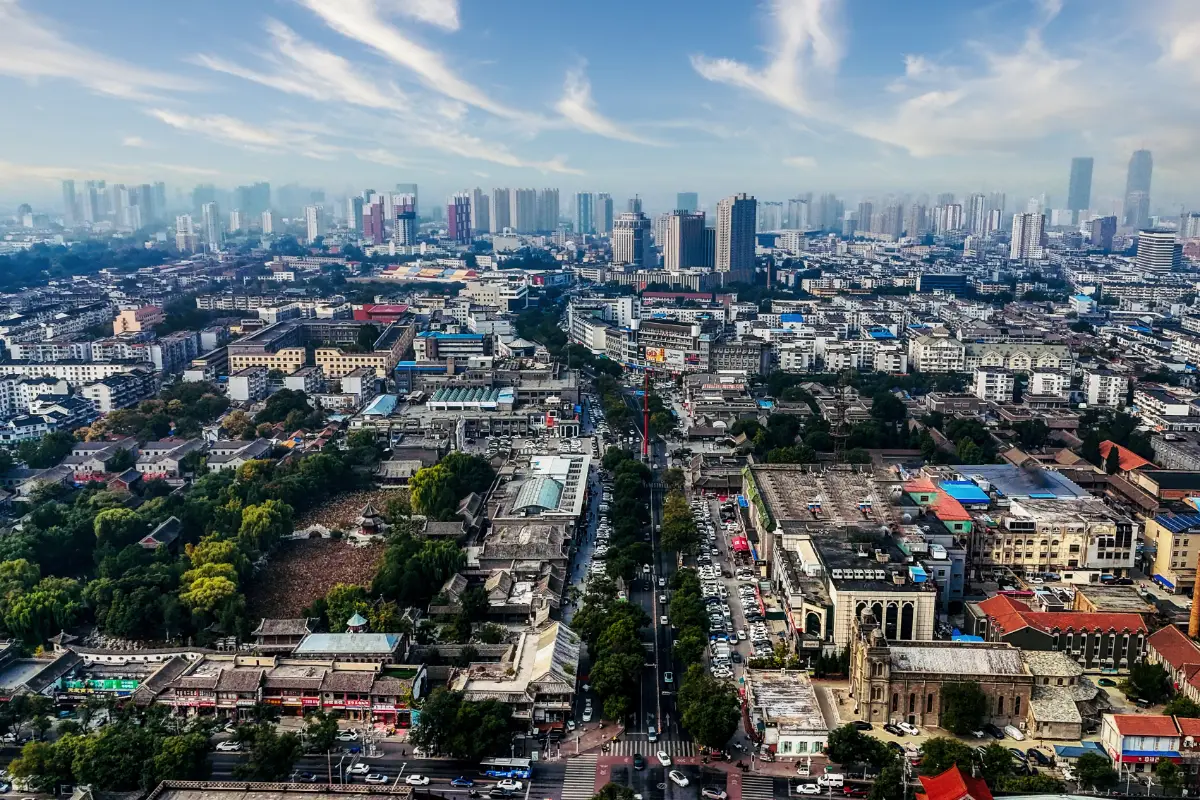
Baoding is not an arbitrary choice. Its formal designation as a Life Health Hub within the Modern Capital Metropolitan Circle (2023–2035) makes it one of the most strategically positioned healthcare cities in China. And at its centre is one of the most ambitious healthcare developments in the country.
km2
Baoding International
Medical Base
Construction began in 2021 on one of China's most ambitious purpose-built healthcare ecosystems - the Baoding International Medical Base. At planned 23 km2 (starting at ~5-7 km2, roughly the size of central Copenhagen), it is not a building or a campus. It is an entire district dedicated to life sciences, healthcare services and medical innovation. The Sino-Nordic Healthcare Center sits within this ecosystem.
The logic behind Baoding is straightforward. The combination of Beijing's medical expertise and Baoding's lower land and labour costs has made the city a magnet for healthcare in northern China. Rather than adding to the pressure on Beijing's central hospitals, people from across Hebei province now travel to Baoding for high-end procedures.
Several of China's leading hospital groups have established major branches in the city. Among those that have established a presence is Peking University First Hospital, which has brought the intellectual centre of Chinese medicine directly to Baoding.
Baoding's defined roles
Life health hub
Designated role within the Metropolitan Circle strategy, anchoring the region's medical and elderly care development
International medical centre district
A dedicated cluster for specialised care, medical research and large-scale rehabilitation facilities
Silver economy hub
Integrated medical-nursing ecosystem combining smart technology with traditional care - a national model for sustainable ageing
Life sciences production base
A dense network of pharmaceutical and medical device companies making Baoding one of China's largest health exports bases
The logic
Why this structure
District-government counterpart
A formal agreement with the Jingxiu District Government creates regulatory standing and direct access to the local healthcare ecosystem - not through a commercial intermediary, but through a counterpart with operational authority in-market. That distinction matters for both credibility and execution.
Baoding as strategic location
Baoding holds a formal designation as Life Health Hub within the Metropolitan Circle strategy. The Baoding International Medical Base is an operational ecosystem with established institutional tenants already in place. Entry within this structure is entry within a credible built environment - not a greenfield bet on a location that may or may not develop.
Nordic positioning coherence
Nordic healthcare companies share regulatory heritage, quality positioning, and clinical methodology. A shared platform allows positioning coherence across multiple entrants and reduces the cost of establishing each company's individual credibility in-market. What takes a single company two years to build, the platform partially provides from day one.
Platform entry logic
A single institutional structure shared across multiple Nordic companies reduces the fixed cost and regulatory overhead of entry for each participant - without diluting their commercial independence. The platform is not a joint venture. Each company enters on its own commercial terms.